Uzbekistan’s historic cities are among the richest architectural landscapes in the Islamic world. Knowing a few building types and periods makes a walk through Samarkand, Bukhara or Khiva far more rewarding.
Building with brick, tile and wood
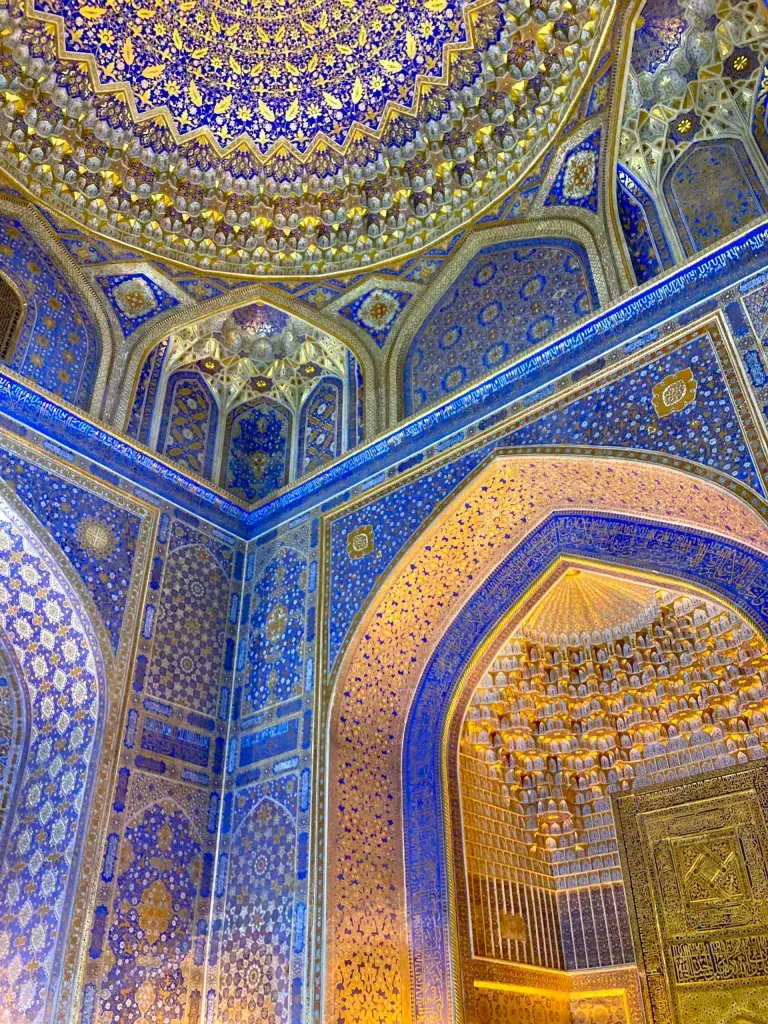
With little stone available on the plains, Central Asian builders became masters of fired brick. Early buildings used patterned brickwork alone to create texture and shadow. From the twelfth century, glazed tiles were added, first sparingly, then, under the Timurids, covering entire façades and domes. Interiors were decorated with carved and painted plaster (ganch), and carved wood was used for columns, doors and ceilings, especially in Khiva.
The main building types
Madrasas
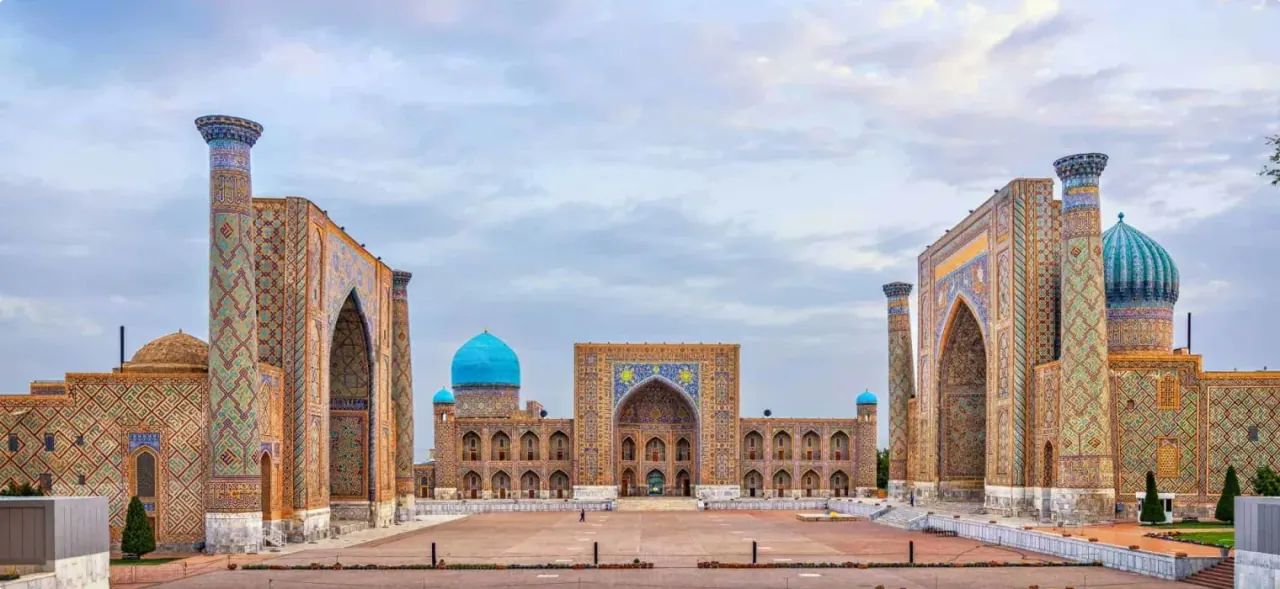
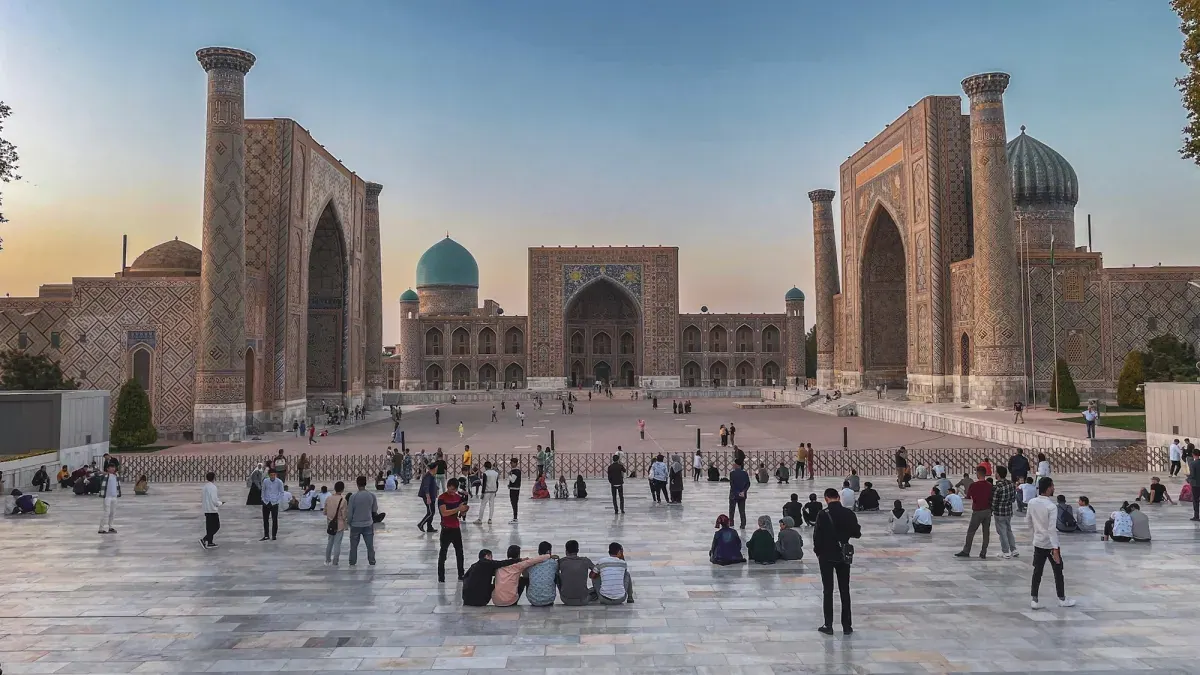
The madrasa, or Islamic college, is the defining building of Uzbekistan’s old cities. A typical madrasa is arranged around a rectangular courtyard surrounded by one or two storeys of students’ cells (hujras). On each side of the courtyard, a vaulted hall (iwan) opens inwards. Facing the street is a monumental arched portal, the pishtaq, often flanked by small minarets or towers. On Registan Square in Samarkand, three madrasas face one another across the square: those of Ulugh Beg (1417–1420), Sher-Dor (1619–1636) and Tilya-Kori (1647–1660).
Mosques
Two types are common. Friday mosques (jome or juma) were built for the whole community’s weekly prayer and could be huge. Bukhara’s Kalyan Mosque can hold thousands of worshippers, and the Bibi-Khanym Mosque in Samarkand was one of the largest of its time. Smaller neighbourhood mosques often have an elegant wooden porch (ayvan) supported by carved columns, as at Bukhara’s Bolo-Hauz Mosque (1712). Khiva’s Juma Mosque is famous for its forest of more than two hundred carved wooden columns.
Minarets
Minarets served as towers for the call to prayer and as landmarks for travellers. The Kalyan Minaret in Bukhara, built in 1127 under the Karakhanids, is a masterpiece of decorative brickwork and has dominated the city’s skyline for nearly nine centuries. In Khiva, the stout, tile-covered Kalta Minor was left unfinished in the 1850s, while the slender Islam Khoja minaret, built in the early twentieth century, is the tallest in the city.
Mausoleums
Tombs of rulers and holy figures are among the most beautiful buildings in the country. The Samanid Mausoleum in Bukhara, from the late ninth or early tenth century, is a cube of patterned brick and one of the most important surviving examples of early Islamic architecture in Central Asia. Gur-e-Amir in Samarkand, the tomb of Amir Temur, crowned by a ribbed turquoise dome, is often described as a forerunner of the great Mughal tombs of India built by Temur’s descendants. The Shah-i-Zinda necropolis in Samarkand lines a narrow street with mausoleums covered in some of the finest glazed tilework anywhere.
Fortresses and palaces
Rulers lived in fortified citadels (ark). Bukhara’s Ark stands on a high artificial mound and was the seat of the emirs until 1920. Khiva’s Kunya-Ark and the nineteenth-century Tosh-Hovli Palace show the private world of the khans, with harem courtyards and tiled reception halls. In Karakalpakstan, the mud-brick desert fortresses of ancient Khorezm, such as Ayaz-Kala and Toprak-Kala, are far older, dating from before and around the turn of the first millennium CE.
Trading domes and caravanserais
Commerce had its own architecture. Bukhara’s sixteenth-century trading domes (toki) cover busy street crossings, and covered markets (tim) and caravanserais accommodated merchants and their goods. Read more in our guide to the Silk Road.
Timurid architecture
Under Amir Temur and his successors, architecture became a statement of imperial power. Buildings grew enormous, with soaring portals, double-shell domes raised on high drums and façades covered in glazed brick, tile mosaic and inscriptions in Kufic and other scripts. Craftsmen brought to Samarkand from across the empire combined Persian, Central Asian and other traditions. The surviving monuments of Samarkand and the ruins of the Ak-Saray palace in Shakhrisabz are the finest examples.
Decoration and its meaning
Islamic architecture avoids human images in religious settings, so decoration relies on geometric patterns, flowing plant motifs (islimi) and calligraphy. The eight-pointed star, interlaced polygons and infinitely repeating patterns are typical. A notable exception is the Sher-Dor Madrasa on Registan Square, whose portal shows tigers (or lions) chasing deer beneath a sun with a human face, a rare and much-discussed image.
Heritage in the twentieth century and today
Many monuments were damaged by earthquakes, neglect and war, and much of what visitors see has been restored during the twentieth and twenty-first centuries. Restoration standards have sometimes been debated: UNESCO has, for example, raised concerns about large-scale reconstruction in Shakhrisabz, which has been on the List of World Heritage in Danger since 2016.
Tashkent tells a different architectural story. After the 1966 earthquake, the city was rebuilt with bold modernist buildings that drew on traditional motifs, and in 2026 a group of them was inscribed on the World Heritage List as Tashkent Modernist Architecture: Modernity and Tradition in Central Asia.
Frequently asked questions
What is a madrasa?
A madrasa is a traditional Islamic college. In Central Asia, madrasas are usually built around a courtyard lined with students' rooms (hujras), with a monumental portal (pishtaq) facing the street and lecture halls or a mosque in the corners.
Why are the domes in Samarkand blue?
Turquoise and cobalt glazed tiles became a hallmark of Timurid architecture in the late fourteenth and fifteenth centuries. The colours were associated with the sky and with paradise, and the glazes protected the brick structure from the weather.
Can visitors enter mosques and madrasas?
Most historic madrasas and many mausoleums are open to visitors, often as museums or craft workshops, usually with an entrance ticket. Active mosques may restrict access during prayer times. Dress modestly and follow your guide's advice.