Uzbek culture blends the traditions of settled Persian-speaking oasis towns with those of Turkic nomads, all shaped by Islam and by centuries of exchange along the Silk Road. Visitors usually notice two things first: the warmth of the welcome, and the colour of everyday life.
Hospitality
Hospitality is a point of honour. A guest is traditionally offered tea before anything else, along with bread, fruit, nuts and sweets laid out on the dastarkhan, the tablecloth spread for guests. It is polite to accept at least a little of what you are offered. The host usually pours tea only partly into the bowl (piala), so that it can be refilled often and stay hot; a full bowl can even suggest that a guest should not stay long.
Bread (non) has an almost sacred status. It is broken by hand, never cut with a knife at the table in traditional households, never placed upside down and never thrown away.
Family and the mahalla
Family is the centre of social life, and several generations often live together. Respect for elders is deeply rooted: older people are greeted first and served first.
Cities are traditionally organised into mahallas, neighbourhood communities that organise mutual help, celebrations and ceremonies. In the old quarters of Bukhara and Khiva, family houses still look inwards onto shaded courtyards behind plain outer walls.
Celebrations of life
Weddings are the biggest events in Uzbek family life and may involve hundreds of guests, music, dancing and a morning feast of plov for the men of the neighbourhood. The birth of a child, a boy’s circumcision ceremony (sunnat toy) and other milestones are also marked with large gatherings. See our guide to festivals and celebrations.
Traditional clothing
Today most Uzbeks wear modern clothes, but traditional dress appears at celebrations and in rural areas. The doppi (or tubeteika), a square or round embroidered skullcap, is the best-known item, with patterns that differ by region. Men’s padded robes (chapan) are worn in winter and given as gifts of honour. Women’s dresses and robes are often made from atlas or adras, silk and silk-cotton fabrics dyed using the ikat technique.
Music and dance
Uzbek classical music is built on Shashmaqom (“six maqoms”), a sophisticated system of vocal and instrumental suites shared with Tajik tradition and inscribed by UNESCO as Intangible Cultural Heritage in 2008. Folk traditions include the epic songs of the bakhshi storytellers and the powerful katta ashula singing.
Instruments include the long-necked dutar and tanbur, the rubab, the frame drum doira and the long trumpet karnay, whose deep sound announces weddings and festivals. Dance differs by region: the lively Lazgi of Khorezm, inscribed by UNESCO in 2019, is famous for its expressive hand and shoulder movements.
Craftsmanship
Silk and ikat
Silk production has a long history in Uzbekistan, especially in the Fergana Valley. Threads are tie-dyed before weaving to create the blurred, flame-like patterns of ikat. In Samarkand and Bukhara, workshops still produce silk carpets and fabrics on hand looms.
Embroidery
Suzani, large embroidered hangings and bedspreads, are among the most collectable textiles in Central Asia. Each centre, such as Bukhara, Samarkand, Nurata and Shakhrisabz, has its own palette and motifs.
Ceramics
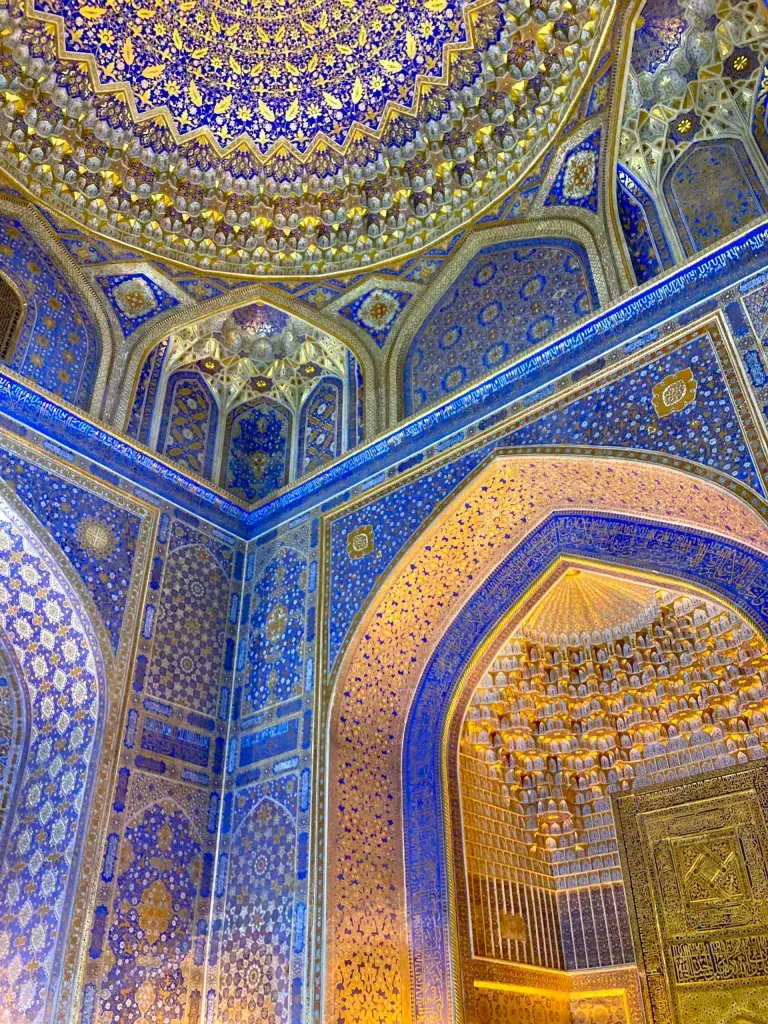
Uzbek potters produce distinctive regional styles: the green and ochre wares of Rishtan and the bold blues of Khorezm, among others. Tiles and ceramics from Uzbek workshops still decorate restored monuments.
Carpets
Hand-knotted carpets in wool and silk are made in Bukhara, Samarkand and Khiva, often in workshops where visitors can watch the weavers at work.
Wood carving, metalwork and miniature painting
Khiva is renowned for wood carving, seen in its carved columns and doors. Bukhara has long traditions of metal chasing, knife-making and miniature painting, an art inscribed by UNESCO in 2020 as shared heritage with other countries.
Regional differences
Uzbekistan’s regions keep their own identities. Khorezm has its own dialect, music and dance and the famous wooden architecture of Khiva. Karakalpakstan in the west is home to the Karakalpaks, a Turkic people with their own language and traditions, from felt-making to epic poetry; learn more on our Nukus and Karakalpakstan page. Bukhara and Samarkand have long had a large Tajik-speaking population, while the Fergana Valley is the heartland of silk weaving and ceramics.
Frequently asked questions
What is the etiquette when invited into an Uzbek home?
Remove your shoes at the door, accept the tea and bread you are offered, and use your right hand to give and receive. Bread (non) is treated with great respect: it should never be placed upside down or thrown away. A small gift such as sweets is always appreciated.
Where can I see traditional crafts?
Bukhara and Khiva have many workshops in their old towns, and Samarkand is known for silk carpets and paper-making. Our gastronomic tour includes a carpet-making master class, a pottery workshop and a knife-making master class in Bukhara.
What is a suzani?
A suzani is a large hand-embroidered textile, traditionally made by women for a bride's dowry and used to decorate the home. Patterns of flowers, vines and sun-like medallions vary from city to city.