For more than a thousand years, the cities of present-day Uzbekistan were among the leading centres of learning in the Islamic world. Mosques, madrasas and shrines are not only architectural monuments; they are reminders of a scholarly tradition that shaped mathematics, astronomy, medicine and religious thought far beyond Central Asia.
Before Islam
The ancient peoples of Sogdiana, Khorezm and Bactria practised forms of Zoroastrianism and local cults, and fire temples have been found at many archaeological sites. Trade along the Silk Road brought Buddhism, which flourished around Termez in the Kushan period, as well as Manichaeism, Nestorian Christianity and Judaism. The region was religiously diverse long before the arrival of Islam.
The arrival of Islam
Arab armies brought Islam to the region in the early eighth century. Over the following centuries it became the dominant religion, and by the time of the Samanids (819–999), Bukhara was celebrated across the Muslim world as a centre of learning. Most Muslims in Uzbekistan follow the Hanafi school of Sunni Islam. The theologian Abu Mansur al-Maturidi of Samarkand (died 944) founded one of the main schools of Sunni theology.
Great scholars of Central Asia
- Muhammad al-Bukhari (810–870), born in Bukhara, compiled Sahih al-Bukhari, one of the most respected collections of hadith (traditions of the Prophet Muhammad). His memorial complex near Samarkand is a major pilgrimage site. Another great hadith scholar, al-Tirmidhi, came from Termez.
- Muhammad ibn Musa al-Khwarizmi (c. 780–c. 850), from Khorezm, worked in Baghdad. His treatise on calculation gave us the word algebra (from al-jabr), and the word algorithm comes from his name.
- Abu Rayhan al-Biruni (973–after 1050), also from Khorezm, wrote on astronomy, mathematics, geography and the cultures of India, and estimated the Earth’s radius with remarkable accuracy.
- Abu Ali ibn Sina (Avicenna, 980–1037), born near Bukhara, wrote the Canon of Medicine, which was used as a medical textbook in Europe and the Islamic world for centuries.
- Ulugh Beg (1394–1449), Timurid ruler of Samarkand, founded a madrasa and an observatory whose star catalogue was one of the most accurate of its time. Learn more in our history guide.
Many of these scholars wrote in Arabic or Persian and worked across the Islamic world, so several countries today honour them as part of their heritage.
Madrasas: centres of learning
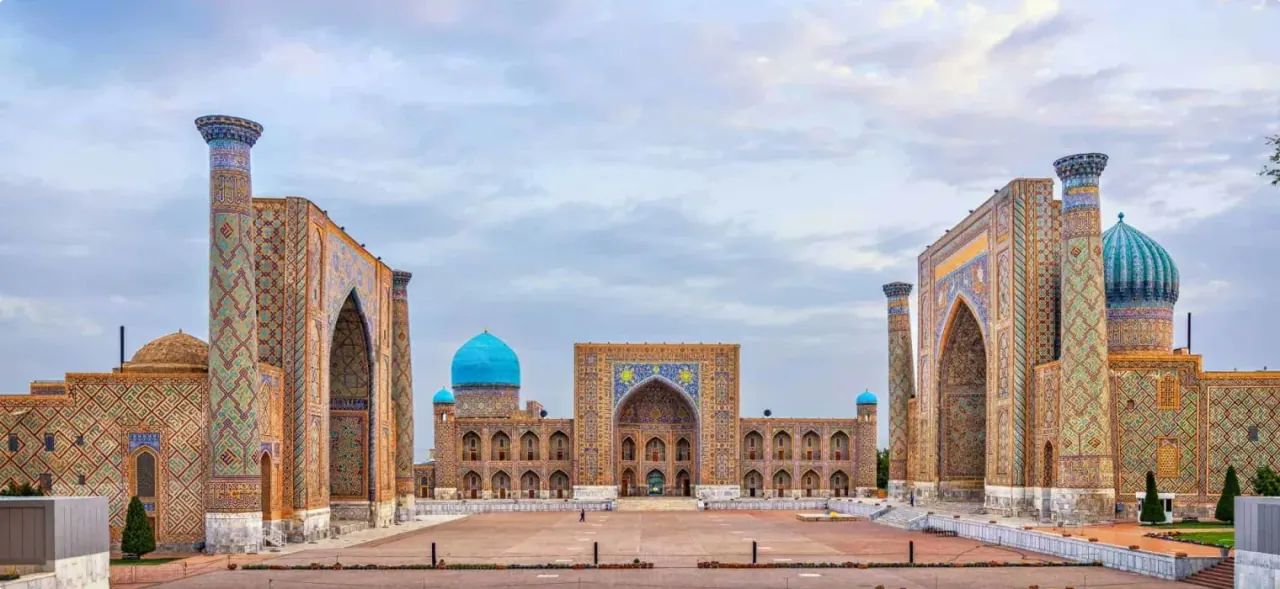
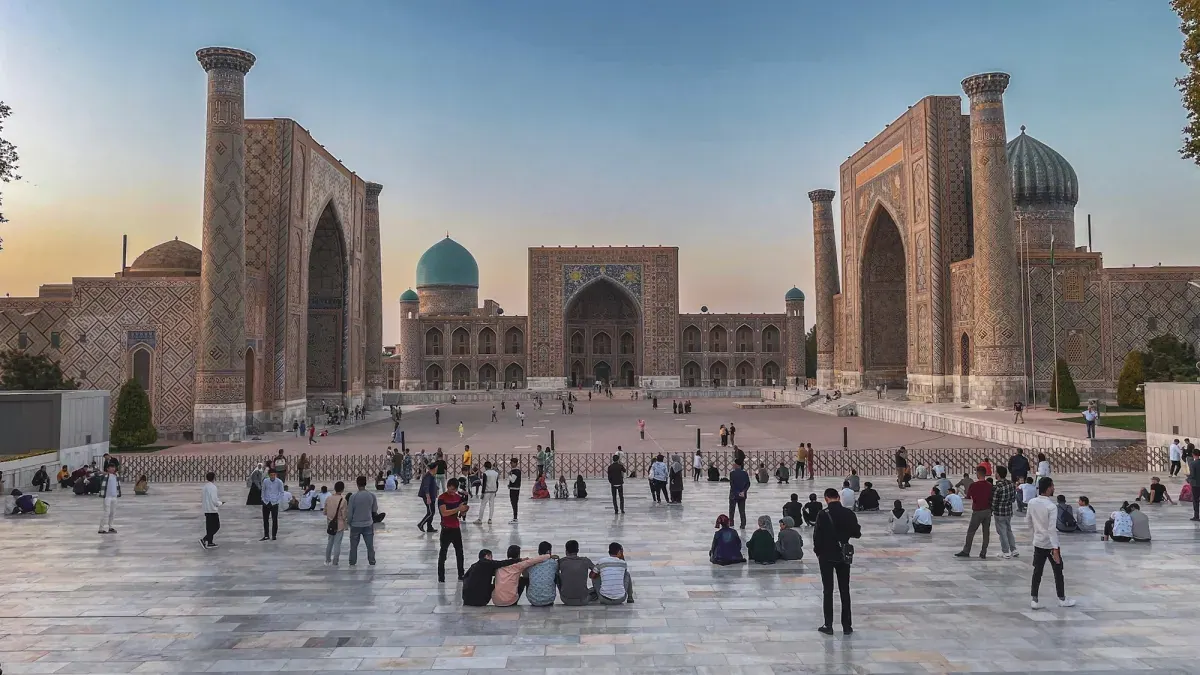
Madrasas were the universities of their time. Students lived in small cells around a courtyard and studied the Quran, law, theology, logic, Arabic grammar and, in some institutions, astronomy and mathematics. The Ulugh Beg Madrasa on Samarkand’s Registan Square was known for teaching the sciences. In Bukhara, the Mir-i-Arab Madrasa has continued to function as a religious school for much of its history.
Sufism and pilgrimage
Sufism, the mystical tradition of Islam, has deep roots here. Bahauddin Naqshband (1318–1389) founded the Naqshbandi order near Bukhara; it later spread from the Ottoman Empire to India. His memorial complex outside Bukhara is visited by pilgrims from many countries.
Pilgrimage to holy sites (ziyarat) remains part of local life. Important places include the Shah-i-Zinda necropolis in Samarkand, traditionally associated with Kusam ibn Abbas, a cousin of the Prophet; the Chashma-Ayub spring in Bukhara, linked to the prophet Job (Ayub); and the Pahlavan Mahmud complex in Khiva, the tomb of a poet, philosopher and wrestler revered as the city’s patron.
Sacred manuscripts
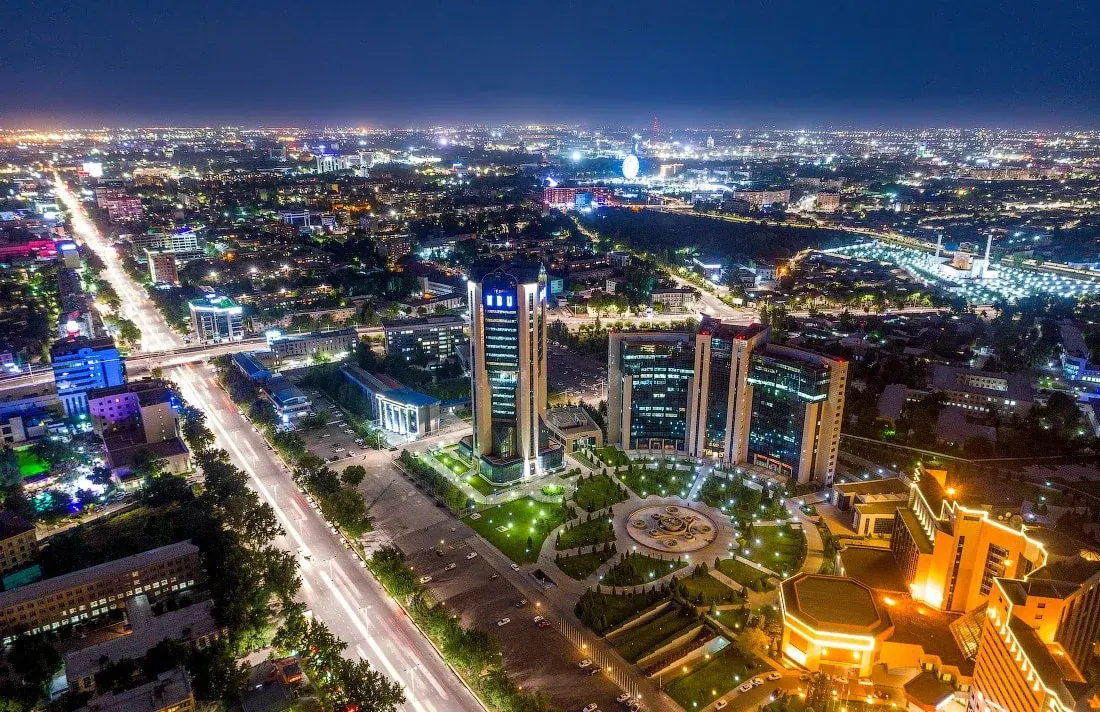
The Hazrati Imam (Hast Imam) complex in Tashkent houses a famous early Quran manuscript, traditionally associated with the third caliph, Uthman, in the seventh century. Many scholars question this attribution, but the manuscript is very old and widely regarded as one of the most important Quran manuscripts in the region. It is displayed in the Muyi Muborak library and can be seen on our Tashkent city tour.
Religion in Uzbekistan today
Uzbekistan is a secular state. The majority of the population is Muslim, and there are also Russian Orthodox, Catholic, Jewish and other communities; Bukhara’s Jewish community has a particularly long history. Religious holidays such as Ramazon Hayit (Eid al-Fitr) and Qurbon Hayit (Eid al-Adha) are public holidays.
Visiting religious sites respectfully
- Dress modestly: cover shoulders and knees; women may be asked to cover their hair.
- Remove shoes before entering prayer areas and carpets.
- Avoid visiting active prayer halls during prayer times, especially at midday on Fridays.
- Ask before photographing worshippers or pilgrims.
Frequently asked questions
Can non-Muslims visit mosques and shrines in Uzbekistan?
Yes. Most historic mosques, madrasas and mausoleums welcome respectful visitors of all faiths, often as museums. Dress modestly, remove shoes where required, keep voices low and avoid entering prayer halls during services.
Who was Imam al-Bukhari?
Muhammad ibn Ismail al-Bukhari (810–870) was born in Bukhara and compiled Sahih al-Bukhari, regarded by Sunni Muslims as one of the most authoritative collections of hadith. His memorial complex near Samarkand is a major place of pilgrimage and is included in our Samarkand city tour.
What is the Naqshbandi order?
The Naqshbandi is a Sufi order founded by Bahauddin Naqshband (1318–1389) near Bukhara. It became one of the most influential Sufi brotherhoods in the Islamic world. His memorial complex outside Bukhara is a place of pilgrimage.