Few places are as closely associated with the Silk Road as Uzbekistan. For centuries, the oasis cities between the Amu Darya and Syr Darya were where caravans rested, goods changed hands and ideas travelled between East and West.
A network, not a road
The term “Silk Road” was popularised in the nineteenth century by the German geographer Ferdinand von Richthofen. It describes not a single highway but a web of overland routes, and connecting sea lanes, that linked China with Central Asia, India, Persia, the Middle East and the Mediterranean from around the second century BCE until the early modern period.
Few merchants travelled the entire distance. Goods moved in stages from one market to the next, and Central Asian cities grew rich as the places where these exchanges happened. The routes also shifted over time with politics, warfare and the fortunes of individual cities.
What was traded
Chinese silk gave the routes their modern name, but it was only one of many goods. Caravans carried textiles, horses, furs, spices, precious stones, glass, metalwork, ceramics and medicines. Central Asia was famous for its horses, its fruit and its fine cotton and silk fabrics.
Paper is one of the best-known examples of technology moving west. Samarkand became an important centre of papermaking in the Islamic world from around the eighth century, and the craft has been revived there today.
The Sogdian merchants
Between roughly the fifth and eighth centuries CE, merchants from Sogdiana, the region around Samarkand and Bukhara, dominated much of the overland trade. Sogdian communities were established along the route deep into China, and the Sogdian language became a common tongue of commerce. UNESCO highlights this period as one of the most prosperous in the history of the Zarafshan valley.
More than goods: an exchange of ideas
The Silk Road carried religions, languages, technologies and artistic styles as well as merchandise. Zoroastrianism, Buddhism, Manichaeism, Christianity and later Islam all travelled these routes. Mathematics, astronomy, medicine and music passed between civilisations, and Central Asian scholars such as al-Khwarizmi and al-Biruni became part of this exchange. See our guide to religion and scholarship.
Caravanserais, bazaars and trading domes
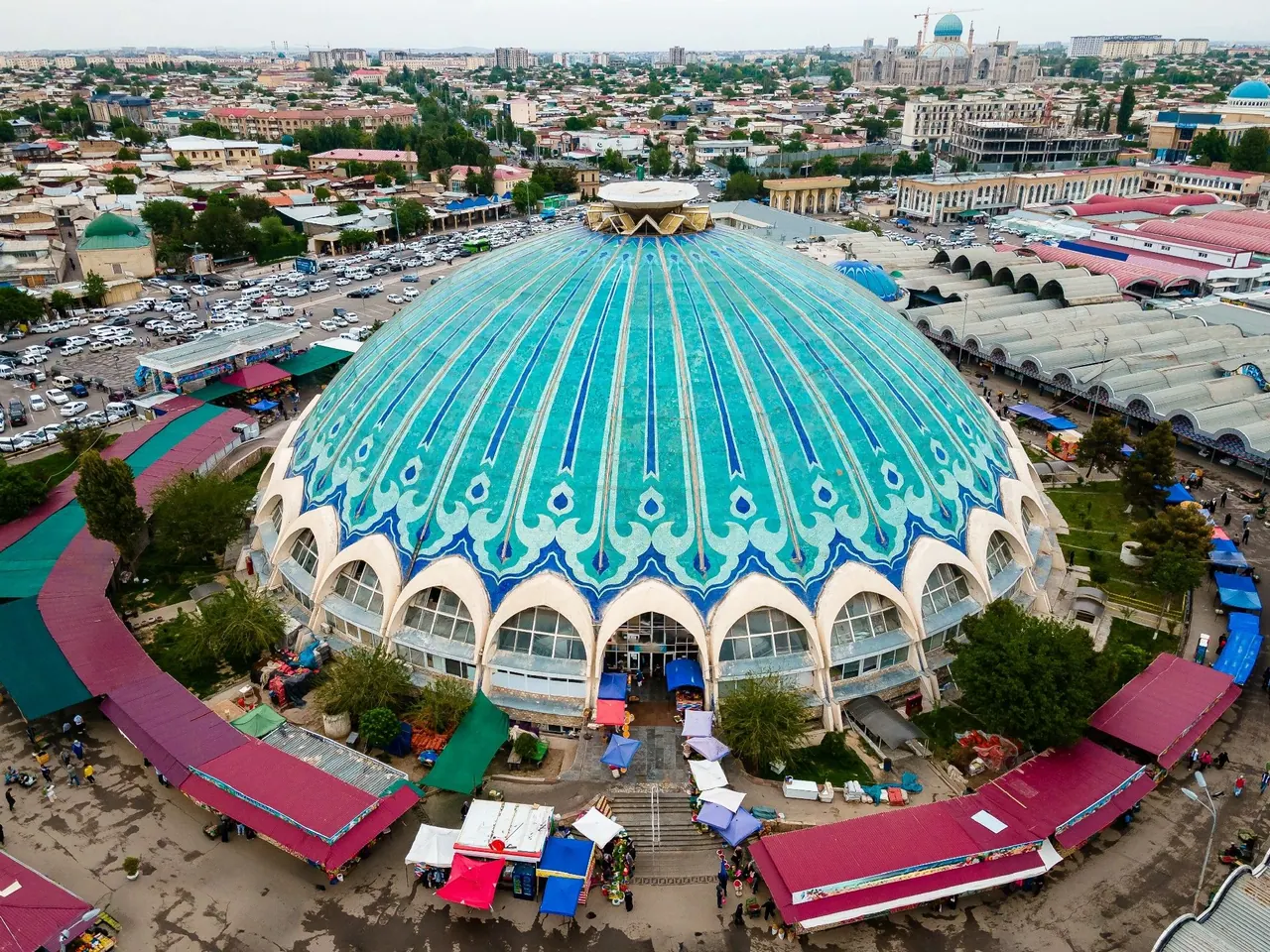
Trade shaped the form of the cities. Along the roads stood caravanserais: fortified inns with a central courtyard where travellers, animals and goods could rest safely. In the cities, commerce concentrated in covered markets and at crossroads.
Bukhara still preserves several sixteenth-century trading domes (toki), built over street intersections so that merchants could trade in the shade; each dome once specialised in particular goods, such as jewellery, hats or currency exchange. Khiva’s caravanserai and covered market stand at the gate of its walled inner town. Find out more in our guide to architecture and heritage.
The great cities of the route
Samarkand
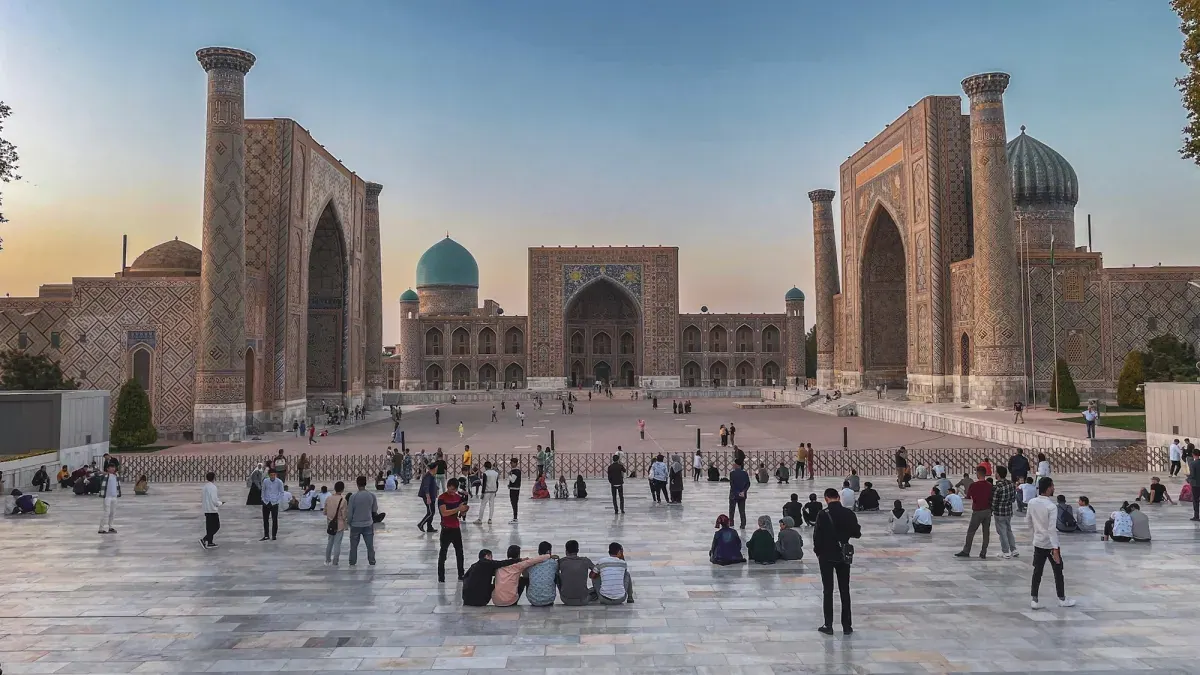
Ancient Maracanda was the capital of Sogdiana and later of Amir Temur’s empire. Its position in the Zarafshan valley made it a natural meeting point of routes, and UNESCO describes it as a “crossroad of cultures”. Discover Samarkand.
Bukhara
A major centre of trade and Islamic learning for more than a thousand years, Bukhara preserves an exceptionally complete historic centre, from the tenth-century Samanid Mausoleum to its trading domes and madrasas. Discover Bukhara.
Khiva
On the lower Amu Darya in Khorezm, Khiva was a last stop for caravans before the desert crossing towards Iran. Its walled inner town, Itchan Kala, became Uzbekistan’s first World Heritage site in 1990. Discover Khiva.
The decline of the overland routes
From the sixteenth century, growing sea trade between Europe and Asia, together with political fragmentation in Central Asia, reduced the importance of the overland caravan routes. The cities of the region remained important regional centres, but the great age of long-distance caravan trade came to an end.
The legacy today
In 2023, UNESCO inscribed the Silk Roads: Zarafshan-Karakum Corridor, a series of 34 sites in Tajikistan, Turkmenistan and Uzbekistan along the Zarafshan River and across the Karakum Desert, on the World Heritage List.
For travellers, the legacy of the Silk Road is still tangible. You can walk under Bukhara’s trading domes, bargain in Samarkand’s Siab Bazaar, watch artisans weave carpets and silk, and travel between the great cities in a few hours on the Afrosiyob train, along a route that caravans once took weeks to cover.
Frequently asked questions
Was the Silk Road a single road?
No. The term describes a shifting network of overland and sea routes that connected China, Central Asia, India, Persia and the Mediterranean over many centuries. Goods usually passed through many hands rather than travelling the whole distance with one merchant.
Which Uzbek cities were on the Silk Road?
Samarkand, Bukhara and Khiva are the best-known, but many other towns, including Termez, Shakhrisabz and the cities of the Fergana Valley, also lay on branches of the routes. Today the Afrosiyob train follows part of the historic route between Tashkent, Samarkand and Bukhara.
Can you still see caravanserais and trading domes?
Yes. Bukhara's covered trading domes (toki) are still used as markets, and caravanserais and madrasas survive in Bukhara, Khiva and Samarkand. The Bukhara programme in our multi-day tours includes the trading domes.